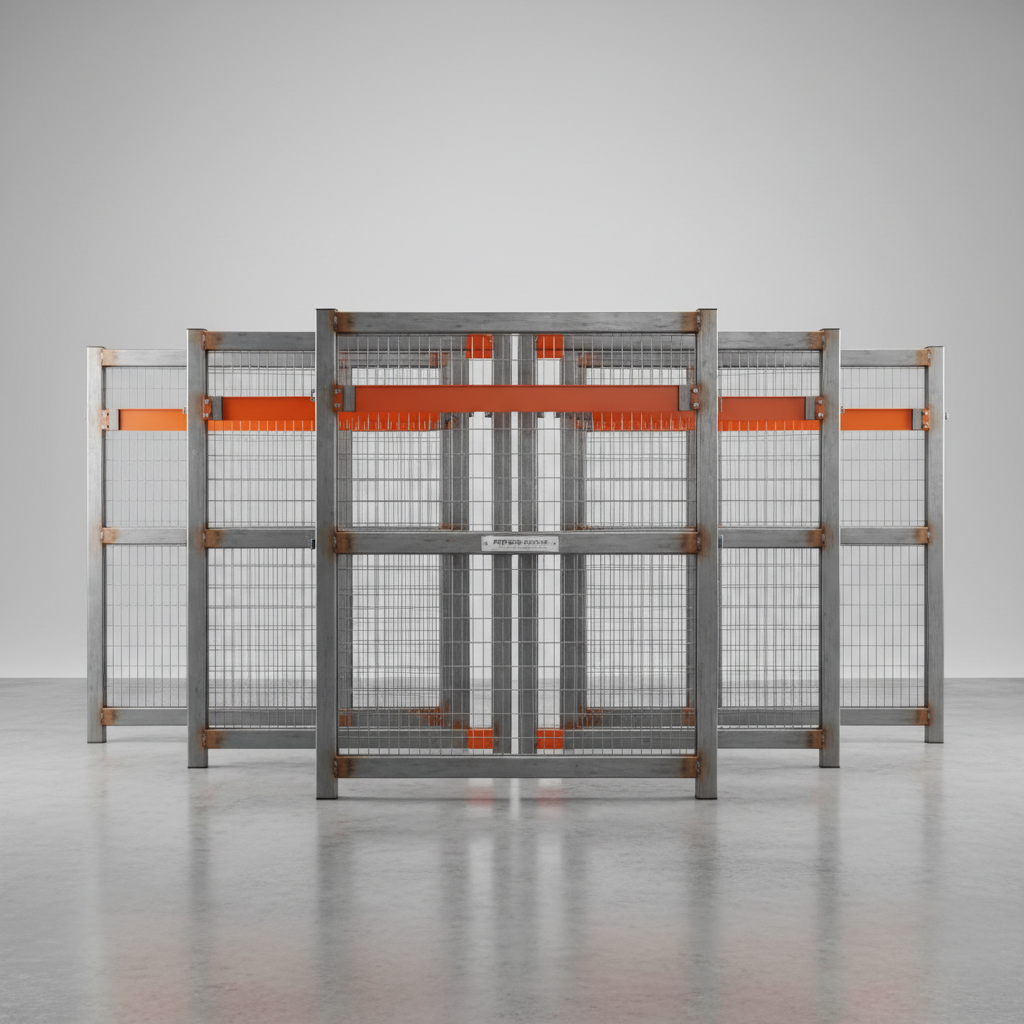
When budgeting for a boundary project, the quest for 6x8 fence panels cheap often leads to a critical trade-off between initial expenditure and long-term durability. For many property owners, the 6-foot height provides necessary privacy and security, while the 8-foot width optimizes the number of posts required, theoretically lowering installation costs.
However, the term "cheap" in the metal fencing industry can be deceptive. The true cost of a fence is not found in the purchase price of the panels, but in the cost of replacement after three years of oxidation or structural failure. Understanding the relationship between material coatings, wire gauge, and structural rigidity is essential to avoid the "cheapness trap."
This analysis explores how to identify high-value, affordable fencing solutions without sacrificing structural integrity, examining the technical specifications that actually drive price and performance in the modern metal wire market.


Choosing a 6x8 configuration is often a strategic move to reduce the total cost of ownership. By increasing the width to 8 feet, the number of posts required for a given perimeter is reduced by roughly 20% compared to standard 6-foot panels. Since posts require deeper excavation and more concrete, this dimensional shift directly lowers labor costs.
However, wider panels place more stress on the remaining posts. To keep the system "cheap" without it becoming unstable, manufacturers often utilize 3D bending or reinforced welded mesh to maintain rigidity across the longer span.
The price of metal panels is primarily dictated by the weight of the steel and the complexity of the surface treatment. A panel that appears cheap at first glance often achieves that price point by reducing the wire gauge (thickness) or using a thinner layer of zinc during the galvanization process. In the manufacturing of welded mesh, the consistency of the weld is a hidden cost; poor welds lead to panels that warp under wind loads.
Another significant factor is the raw material source. Pre-hot dipped galvanized steel tubes, commonly used in high-quality frames, provide a baseline of corrosion resistance that prevents the panel from failing prematurely. When analyzing costs, one must distinguish between "material cost" and "system cost," which includes the hinges, lockers, and lock holders necessary for a complete installation.
Ultimately, the engineering of the panel—such as whether it is a Single Wire Panel or a Double Wire Panel Fence—determines its price bracket. Double wire systems offer significantly higher rigidity for the same height, making them more expensive but reducing the need for frequent intermediate support posts.
Surface treatment is the primary defense against environmental degradation. Most affordable metal fences utilize a combination of hot-dip galvanization and powder coating. The zinc coating (often ranging from 50 g/m² to 275 g/m²) acts as a sacrificial anode, protecting the underlying steel from rust even if the top layer is scratched.
The most cost-effective long-term strategy is not choosing the lowest unit price, but selecting a "zinc-phosphated + powder coated" finish, which creates a chemical bond that prevents peeling and significantly extends the replacement cycle.
For those seeking specific aesthetics without sacrificing protection, RAL colors like 6005 (Green), 7016 (Grey), and 9005 (Black) are industry standards. These coatings are not merely for appearance; they provide an additional barrier against UV radiation and atmospheric pollutants, ensuring that a "cheap" initial investment does not lead to an expensive restoration project in five years.
Different fencing systems offer varying levels of "value per dollar." While a standard welded mesh panel is highly affordable, it may not provide the security required for industrial sites. Conversely, high-security fencing is prohibitively expensive for residential gardens. The goal is to match the material specification to the risk level of the application.
By evaluating relative indices such as durability, installation speed, and initial cost, buyers can identify which system provides the most "utility" for their specific budget constraints.
In a typical industrial setting, the priority is often perimeter containment. Here, a combination of 3D Panel Fencing and dedicated Single Wing Gates for chain-link sections provides a cost-effective solution. The use of Φ60 posts and Φ40 frames ensures that the gates can withstand frequent operation without sagging, which is a common failure point in truly "cheap" systems.
For residential use, the focus shifts toward aesthetics and low maintenance. PVC coated welded fencing is often the preferred choice because it blends with the landscape while resisting the corrosive effects of garden fertilizers and moisture. In these scenarios, the "value" is measured by the absence of need for annual painting or rust treatment.
The industry is moving away from custom-fabricated fences toward standardized modular systems. Modular panels, including temporary panel fences and prefabricated security fences, allow for rapid deployment and easy replacement. This shift has driven down costs because mass production reduces the per-unit overhead.
Furthermore, the integration of comprehensive accessory kits—containing everything from ground spikes to specialized T & L & U posts—means that buyers no longer have to source components from multiple vendors. This streamlines the logistics chain, contributing to a lower overall project price.
The current trend also emphasizes "hybrid" fencing, where a high-security double wire panel is used for the main perimeter, while a more affordable chain link or hexagonal netting is used for secondary internal divisions. This tiered approach allows budgets to be allocated where they are most needed.
To secure a truly affordable fence, a buyer must look past the sticker price and analyze the technical specifications. A critical check is the zinc coating weight; anything significantly below 50 g/m² in a coastal or humid environment is a liability.
Additionally, the method of attachment—whether using clamps or welding—affects both the initial cost and the ease of future repairs. Clamped systems are generally faster to install, reducing labor costs, while welded systems are more rigid.
The following framework provides a relative assessment of different metal fencing options based on common selection criteria to help buyers determine the best fit for their specific constraints.
| System Type | Initial Cost | Durability Index | Installation Speed |
|---|---|---|---|
| Chain Link PVC | Low | Medium | Very High |
| 3D Welded Mesh | Medium | High | High |
| Double Wire Panel | Medium-High | Very High | Medium |
| Ornamental Panel | High | High | Low |
| Temporary Panel | Low | Low-Medium | Instant |
| Security Fence | High | Maximum | Low |
A high-value affordable panel is one that optimizes material use without compromising structural integrity. This is typically achieved through a 3D-bent design that increases rigidity, the use of pre-hot dipped galvanized steel, and a zinc-phosphated powder coating. The goal is to find a product where the "cost per year of service" is low, even if the "cost per panel" is not the absolute lowest in the market.
Increasing the width from 6 feet to 8 feet reduces the total number of posts required for the perimeter. Since the most labor-intensive part of fencing is digging post holes and pouring concrete, fewer posts translate to significantly lower installation labor costs. However, it requires higher-grade panels to ensure the wider span does not bow or sag over time.
PVC coating provides an extra layer of protection and aesthetic versatility. While raw galvanized steel is cheaper, PVC-coated welded fencing is often more cost-effective over a 10-year period because it resists corrosion more effectively in acidic soils or salty air. It eliminates the need for periodic painting, which reduces long-term maintenance expenses.
The primary risks include insufficient zinc coating (leading to rust within 1-2 years), poor weld penetration (causing panels to warp), and thinner gauge wire that can be easily bent or cut. Additionally, very cheap panels often lack standardized dimensions, making it difficult to find matching replacement parts or compatible accessories like hinges and locks in the future.
For most budget-conscious projects, a Single Wing Gate is the most economical choice for pedestrian access. However, for vehicle access, a Double Wings Gate made from pre-hot dipped galvanized steel tubes with PVC-coated chain-link infill provides the best balance of strength and price. Using standard Φ60 posts and Φ40 frames ensures the gate remains functional without requiring expensive heavy-duty reinforcements.
Yes, because modular systems are mass-produced to tight tolerances, they eliminate the need for expensive on-site fabrication. The ability to purchase a complete kit—including panels, posts, and accessories—reduces procurement errors and minimizes material waste. This standardization is the primary driver behind the availability of high-quality, affordable fencing options in the current global market.
Achieving a low-cost boundary solution does not require compromising on quality, provided the buyer focuses on the technical specifications that drive longevity. By prioritizing pre-hot dipped galvanization, appropriate wire gauges, and optimized dimensions like the 6x8 configuration, it is possible to significantly reduce both initial and long-term expenses.
As the industry shifts toward modularity and advanced powder coatings, the gap between "premium" and "affordable" fencing is closing. The key to a successful investment is matching the material's technical capabilities to the specific environmental and security demands of the site.